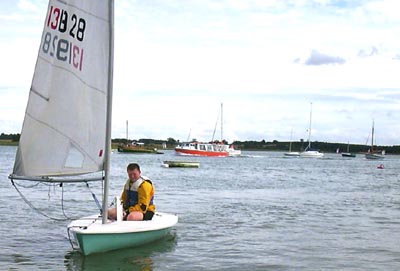
People tend to give me a mildly quizzical look when i mention that i go sailing. ("eek, he's a closet yottie..." etc.)
Well, as you can see, my vessel is decidedly modest. I sail at an idyllic spot in Suffolk. It beats Neasdon.
The dinghy is called a Laser. They've made 175,000 of 'em since 1971, and they're all identical apart from some minor changes, the most recent of which mean that mere mortals can sail them when it's breezy.
While we're at it, here are some other photos from Suffolk.
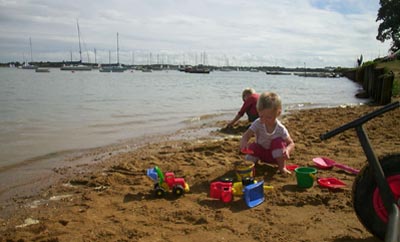
Barney and Rosa at Waldringfield, Aug 2002.
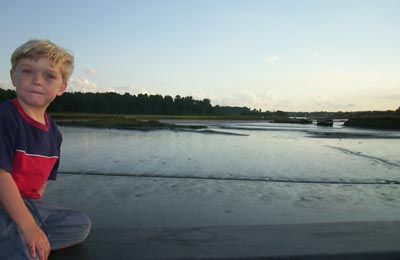
Barney overlooking the Deben & Sutton Hoo, Aug 2002.
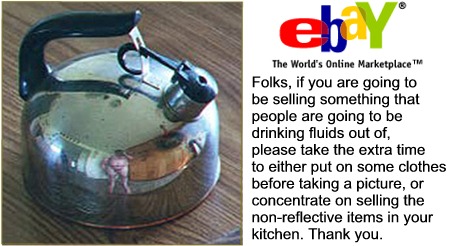
On the back of Paul Hammond's deeply passive personalisation work on the new BBCi homepage, i've been pondering ways of identifying people online or on iTV with low levels of certainty within a very small user group such as a family.
i.e. Is it mum, dad, bro' or sis' picking up the remote / swiping the mouse?
Rather than focus on physical attributes (Alice Taylor's fingerprint scanner in the remote control idea, etc.) or username/pwd key pairs etc, I've been wondering if any of the activities one performs as a normal part of surfing the web / the TV could act as a some kind probablilistic identifier within a very small (family) user group
Some thoughts thus far:
- acceleration of mouse from a standing start
- average mouse overshootiness before a click
- gap between double clicks
- preferred first channel to watch on TV
- length of time keys on the remote are depressed
- liklihood that volume is increased / decreased
All of these are hard to measure, but something like this could make all the difference - particularly on iTV.
I like Aesop's fables, particularly this one
I will read them to my children soon.
Crikey. Azeem has really gone for it with and added lotsa meat to his idea for a BBC Public License
In short, the 'BPL' would allow people to:
- Use BBC content, build on it, add value, build audiences and personal relationships with it.
- Use BBC code, improve on it, make a business from it, give your endeavours away to the community or sell them
- Use BBC services to develop digital society, because the BBC can provide things that the market cant
Hard for me to comment given my circumstances, but please stop reading this, and get over there now.
Quaker schools are passe, darling.
Former Quaker schools are more done thing these days.
Specially when they're 100% vege.
Mans relationship with Nature involves personal responsibility. The School has always followed a wholefood vegetarian diet and the nutritional and moral grounds for this are explained, without labouring the arguments.
I eat meat, natch.
Interesting article by Azeem Azhar proposing an opensource BBC (both code and content)
He pushes the 'you've already paid for it' angle...
Feel free to comment on Azeem's blog